Claude Opus 5.5 vs MiniMax M2.7 highspeed: The Cheapest Card in the Set Meets a $4.00 One
The cheapest card in our twelve-model table sits on this page, beside a card that charges more than six times as much to read from it. On OrcaRouter the Claude Opus 5.5 vs MiniMax M2.7 highspeed comparison is the widest ratio in the set that does not involve a premium endpoint on the far side — no $30.00 card, no twelve-times step. It is a mid-band premium endpoint priced against the absolute floor, and that makes the two cards disagree on every single row rather than on some of them.
Where the two cards sit in the twelve
Read on 2026-10-13:
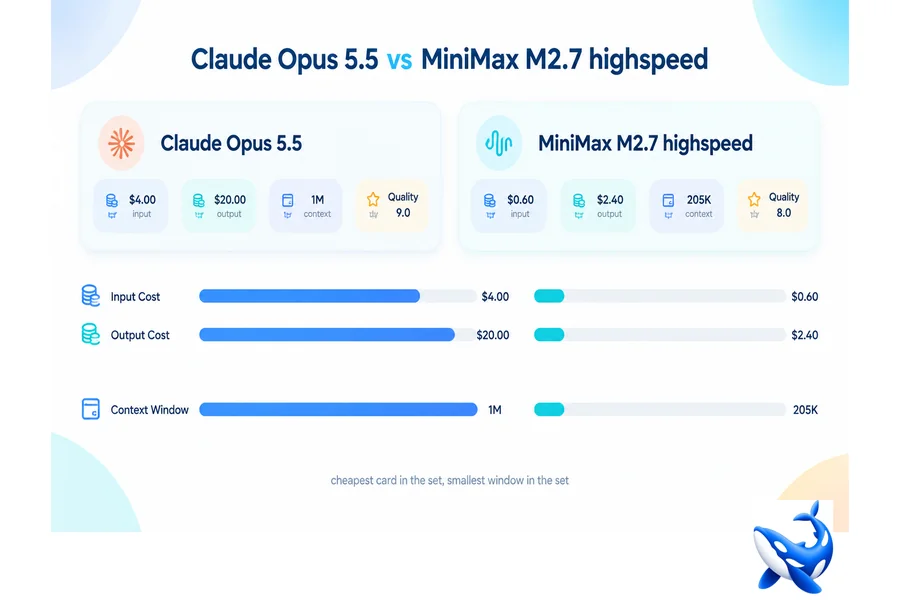
| metric | Claude Opus 5.5 | MiniMax M2.7 highspeed | gap |
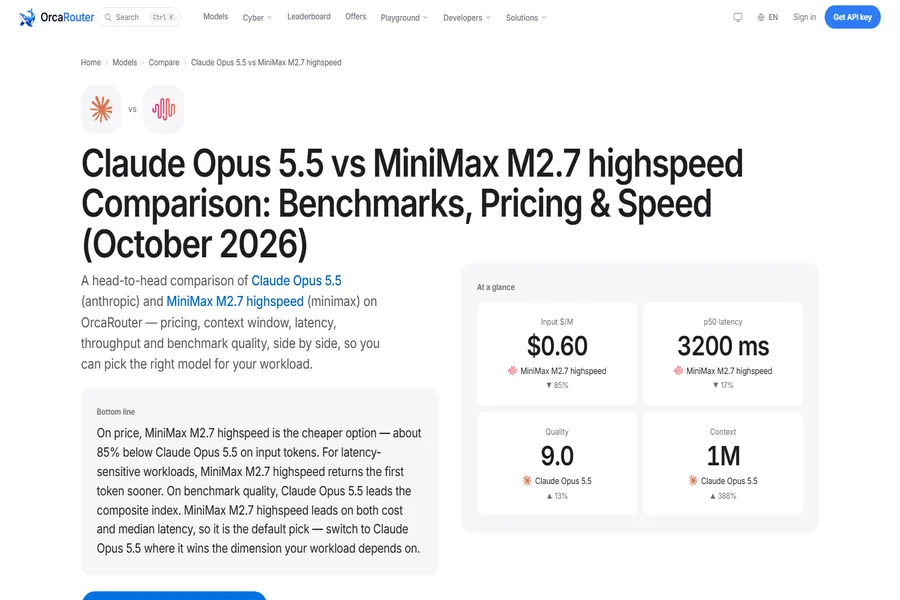
| input, per million tokens | $4.00 | $0.60 | Opus is 6.7x |
| output, per million tokens | $20.00 | $2.40 | Opus is 8.3x |
| output-to-input multiple | 5.0x | 4.0x | MiniMax bills more gently |
| context window | 1M | 205K | Opus holds nearly five times as much |
| composite quality, 0–10 | 9.0 | 8.0 | Opus leads by one point |
Five rows, five differences, and not one of them is a tie or a near-tie. That is unusual. Most of the pairs we publish resolve on two rows and tie on the rest, which is what makes them close calls. This one does not: the more expensive card is also the higher-scoring one and the roomier one, and the cheaper card is cheaper on both price lines and gentler on the output multiple. Every structural advantage is stacked on one side or the other.
The 6.7x, and why it is not the headline
Six and a half times on input is the number that gets quoted, and on its own it is the less interesting half of the price story. The output line is worse. $20.00 against $2.40 is a factor of 8.3, and because the cheaper card also bills output more gently — four times input against five — the gap does not compress as a workload writes more. It is already wide at the read extreme and gets wider toward the write extreme.
That combination is what makes this pair an architectural decision rather than a tuning decision. A ratio that held steady across mixes would let you treat the two cards as the same product at different prices and switch on volume alone. This one does not hold steady, and the capacity row does not hold steady either, so there is no single axis along which moving down the price ladder is a simple step.
One point of composite, at the bottom of the scale
Our composite quality column is ours: a 0–10 figure we compute from four families of evaluation we run against each endpoint — reasoning, code generation, long-context retrieval and instruction following — averaged into one number. It is not a third-party leaderboard, and no other team can reproduce it on their own harness.
Across the twelve models we price, the entire field lives inside two points: three cards at 8.0, six at 9.0, three at 10.0. So Claude Opus 5.5 sits in the crowded middle at 9.0 and MiniMax M2.7 highspeed sits at 8.0, the floor of the measured range. One point is half the entire width of the scale, which sounds like a great deal until you remember what a composite is: an average across four families, and an average flattens the shape of a failure. A card at 8.0 can be strong on the work your pipeline actually does.
That cuts both ways and it is worth saying plainly, because the cheap-card case usually rests on it. One point of composite is a real measured lead on four averaged families. It is not a promise about the specific inputs you send, and it does not tell you which of the two cards wins your hardest task. That is a test, not a column.
What 205K does to a long-document pipeline
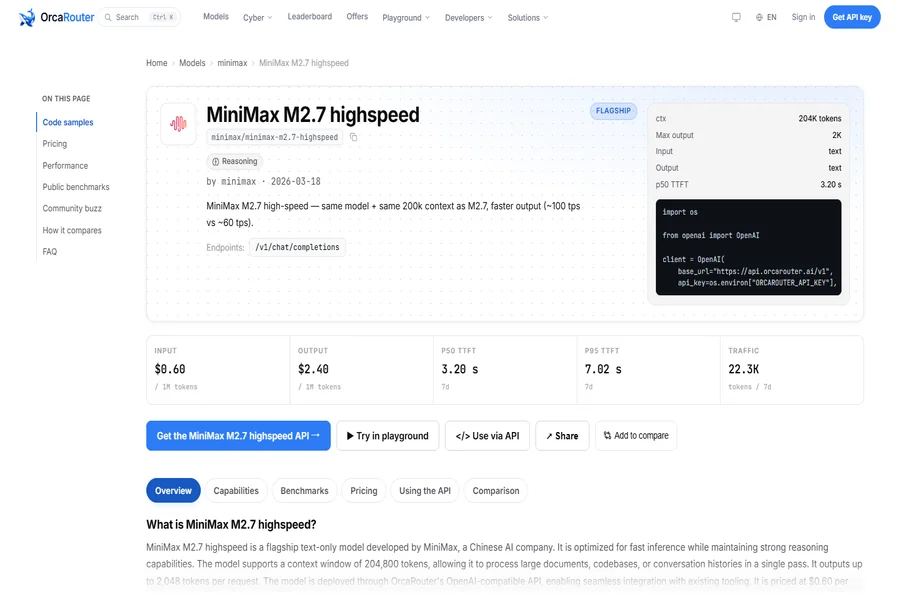
The capacity row is the one people skip, and on this pair it is the row that decides the most. Eight of the twelve models we price carry a 1M context window, and Claude Opus 5.5 is one of them. MiniMax M2.7 highspeed publishes 205K — the smallest figure in the set, below Kimi K2.6’s 262K and Grok 4.7’s 500K.
Two hundred thousand tokens is a lot in absolute terms, and for a great many pipelines it is entirely sufficient: chat with moderate history, single-document summarisation, structured extraction from a contract or a report, code tasks over one or two files. If that describes your traffic, the capacity row is not a constraint and the price rows are the whole comparison.
It stops being sufficient when documents or traces grow. A window that is too small does not raise an error; it forces chunking, and chunking means reading overlapping spans more than once. Read a document twice to work around a window that will not hold it and you have paid the input rate twice — which on MiniMax M2.7 highspeed is $1.20 per million instead of $0.60, still less than a third of what Claude Opus 5.5 charges for a single pass. That arithmetic is worth running before you assume capacity outweighs price on your workload. On this pair it might not.
Priced on a matched pair
The clean way to see the two price rows together is one matched pair. Read a million tokens and write a million through each card. Claude Opus 5.5 bills $24.00. MiniMax M2.7 highspeed bills $3.00. The difference is $21.00 on a single balanced pair — the more expensive card costs exactly eight times the cheaper one.
Eight times is not a rounding difference at any volume, and it is the strongest version of the cheap-card argument on this page. The nuance is that it is the version that assumes the window fits. The moment a document needs a second overlapping pass, the effective rate on the cheaper card roughly doubles, and the multiple narrows. It does not close — $1.20 against $4.00 is still better than three-and-a-half to one — but “eight times cheaper” and “three-and-a-half times cheaper” are different claims, and which one is true depends on your document sizes rather than on the cards.
What the premium card is actually selling
Three things, and they are all on the table. The wider window, the higher composite, and — the one that is easy to miss — the gentler effective behaviour on long inputs, since a card that never needs a chunking layer pays the surcharge zero times.
None of those are abstractions for a workload that reads long documents or runs long agent traces. Retrieval over large corpora, multi-file code review, legal or clinical documents that must be read whole rather than summarised in slices: on all of those the 205K boundary is not a budget line, it is a correctness boundary, because a sub-chunked answer is a different answer. Where the boundary binds, the price comparison stops mattering and the page has already decided itself.
Where it does not bind, the premium buys something you have not measured a need for. That is the honest reading of a one-point composite lead and a five-times-larger window on traffic that fits comfortably in the smaller one.
The takeaway
Claude Opus 5.5 and MiniMax M2.7 highspeed differ on all five rows and tie on none. The cheaper card charges $0.60 and $2.40 per million tokens against $4.00 and $20.00, with a gentler 4.0x output multiple; the more expensive card holds 1M of context against 205K and leads the composite by one point, half the width of the entire measured scale. On a matched million-in, million-out pair the bills are $3.00 and $24.00.
That makes this a capacity decision wearing a price tag. If your documents and traces fit inside 205K — and for a large share of production traffic they do — the cheaper card is the cheaper card by a factor of eight on a balanced pair, and one point of composite is a real but averaged lead. If they do not fit, chunking doubles the effective input rate and returns a different answer to the same question, and the $21.00 stops being the interesting number. Both endpoints are live at list price behind a single key.