The Next Era of Digital Worlds: Automating 3D Asset Creation in Game Design
The landscape of interactive entertainment is undergoing a massive structural shift, primarily driven by the exponential demand for expansive, highly detailed digital environments. Modern game development requires thousands of unique structural assets, character models, and environmental props to populate virtual worlds. Historically, producing these components involved labor intensive manual sculpting, retopology, and texture mapping. This traditional pipeline created immense pressure on technical artists and frequently extended development cycles by several years. However, the introduction of advanced generative algorithms is completely redefining how creative studios approach spatial modeling. At the forefront of this technological revolution is Neural4D, an innovative platform that seamlessly bridges the gap between static illustrations and dynamic dimensional spaces.
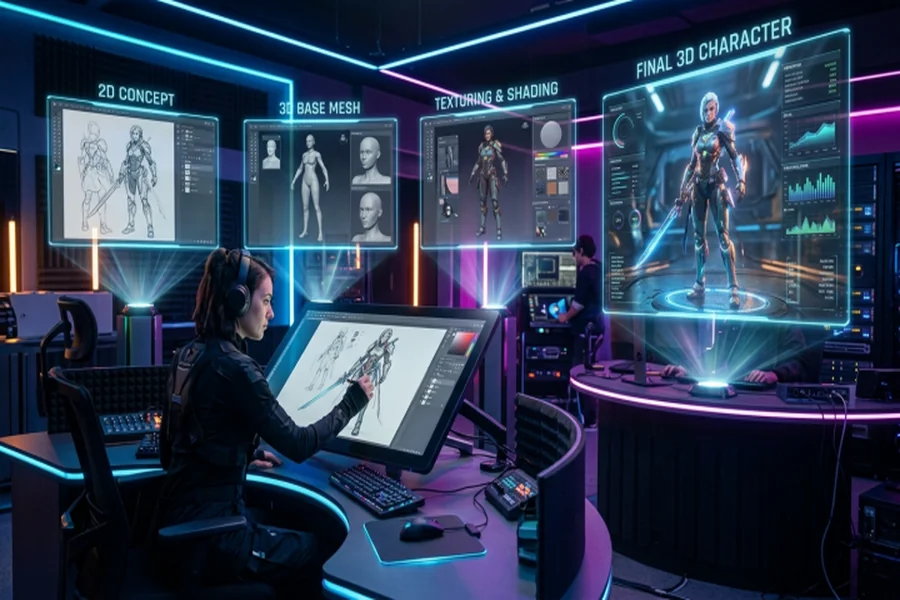
Developed through a robust academic partnership involving Nanjing University, DreamTech, Oxford University, and Fudan University, Neural4D leverages state of the art Spatial Sparse Attention mechanisms to interpret and reconstruct visual data with unprecedented accuracy. A core innovation of this system lies in its ability to understand the dimensional implications of flat artwork. For studios looking to convert a 2D image to 3D model, the platform offers a fully integrated closed loop mechanism. Concept artists can rapidly generate or upload two dimensional character designs, and the underlying inference engine instantly reconstructs them into high fidelity, fully rigged spatial assets ready for deployment in modern game engines.
Overcoming the Bottleneck of Manual Modeling
The traditional character and prop creation workflow is inherently fragmented. An illustrator drafts a concept from multiple angles, which is then handed off to a spatial modeler. The modeler must interpret these flat references and meticulously extrude geometry to match the artist’s vision. This manual translation is not only time consuming but also highly susceptible to misinterpretation, often necessitating lengthy revision cycles between the art director and the modeling team.
Generative reconstruction technologies effectively eliminate this communication gap by automating the translation phase entirely. By utilizing specialized neural networks trained on vast datasets of topological structures, these systems can extrapolate the hidden geometry and volume of an object from a single viewpoint.
- Accelerated Prototyping: Development teams can populate test environments with fully textured placeholder models in a matter of hours rather than weeks, allowing for rapid iteration on level design and spatial pacing.
- Preservation of Artistic Intent: Because the algorithm builds the geometry directly from the source illustration, the final asset perfectly retains the original stylistic nuances, proportions, and shading aesthetics envisioned by the concept artist.
- Optimized Engine Performance: The resulting topology adheres strictly to industry standards, generating lightweight meshes that maintain high visual fidelity without compromising frame rates or rendering performance.
Democratizing High End Asset Production
While AAA gaming studios benefit immensely from the scalability of automated pipelines, the profound impact on independent developers cannot be overstated. Historically, smaller creative teams were forced to compromise on visual ambition due to the prohibitive costs associated with hiring dedicated modeling departments or licensing premium asset packs. Generating bespoke, high quality spatial content was a luxury reserved for those with substantial financial backing.
The democratization of spatial generation empowers independent creators to execute complex visual narratives on a fraction of a traditional budget. A solo developer can now conceptualize a diverse cast of characters, generate the necessary visual references, and extract fully rigged spatial assets using intuitive platforms. This technological accessibility is leveling the playing field, enabling small teams to deliver visually stunning interactive experiences that rival the production quality of massive corporate entities.
The Role of Collaborative Community Ecosystems
As the barriers to asset creation continue to lower, a highly collaborative global community has emerged around the sharing and refinement of spatial models. Developers, designers, and hobbyists actively exchange raw geometry, technical insights, and optimized base meshes to accelerate collective learning. This open source mentality is crucial for standardizing generative workflows across different creative disciplines.
For creators looking to experiment with varied structural foundations or seeking verified geometry for physical prototyping, repositories like the DIY3D free STL and 3MF files catalog provide an invaluable resource. These centralized hubs offer independent developers access to a wealth of community validated models, further reducing the time required to establish a functional asset library. By leveraging these shared resources, creators can bypass foundational modeling challenges and dedicate their focus entirely to gameplay mechanics and interactive storytelling.
Technical Nuances of Spatial Extrapolation
Reconstructing accurate spatial data from a flat image requires a sophisticated understanding of lighting, material properties, and perspective geometry. When a human artist looks at a flat drawing of a sphere, they intuitively understand its volume based on the distribution of light and shadow. Teaching a machine to replicate this intuitive understanding is a complex computational challenge, particularly when dealing with stylized or non photorealistic artwork.
Advanced inference engines solve this by separating the visual data into distinct analytical layers. The system first evaluates the silhouette to determine the bounding volume, then analyzes the internal shading gradients to infer depth, and finally evaluates color information to generate corresponding texture maps.
- Intelligent Depth Inference: The algorithm can predict the curvature and depth of surfaces hidden from the camera’s view, ensuring the final object maintains structural integrity from all angles.
- Automated UV Unwrapping: Modern pipelines eliminate one of the most tedious aspects of manual modeling by automatically mapping the two dimensional color data accurately onto the newly generated three dimensional surface without stretching or distortion.
- Predictive Skeletal Rigging: For character models, the system goes beyond static geometry by identifying joint locations and automatically applying a standard skeletal rig, significantly streamlining the animation pipeline.
The integration of automated structural generation into digital design workflows is not merely a supplementary tool; it represents a fundamental paradigm shift in interactive media production. By bridging the critical gap between conceptualization and execution, developers are granted the freedom to prioritize creative exploration over tedious technical execution. The ability to instantly materialize complex digital assets from flat illustrations is establishing a new operational standard, one that promises to unlock unprecedented levels of visual ambition and interactive complexity in the gaming industry.